Fishing

Elliot Lake is at the heart of an incredible fishing region that contains over 4,000 lakes. These lakes hold one of the world's most prolific trout fisheries. It is one of Ontario's only self-sustaining, inland three-species trout system.

Lake Access and Licences

You can access many lakes through community boat launches or a quick hike. When the lakes are harder to reach, you can often reach them in the wintertime. Enjoy isolated fishing adventures, or take part in guided trips and special ice fishing derbys.

For fishing regulations, including licence requirements, seasons and limits, visit the Government of Ontario's website.

Fish Size and Fish Stocking

Many fish that come from our lakes (some are 300 feet deep) are often trophy-sized. Check out the Elliot Lake Trading Post to see what our area's fishermen have caught in the past and to shop for all your fishing needs.

Elliot Lake is part of a provincial fish stocking program that ensures good fishing for years to come.

Species of Fish and Fishing Map

You can fish for 10 species around Elliot Lake.

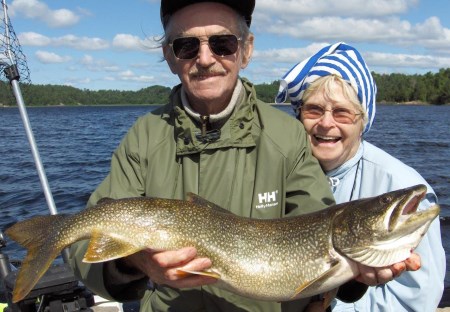
big lake trout

You can catch Lake trout through deep-water trolling. Some anglers spin- or fly-fish. Proven lures are spinners, spoons, plugs, streamers and wet flies. The best live bait is minnows. Boats and canoes provide better access to lake trout.

  • Average size: 2 - 10 lbs (0.9 kg to 4.5 kg)
  • Temperature and habitat: Around 10 degrees Celsius in clear, deep lakes
  • Spawns in the fall over boulders or rubble shoals in lakes
  • Can live 20 years or longer

Use boats and canoes to find most Brook trout in the area. It is best to fish near overhanging trees, submerged wood and rocky points and shoals. They are most active in the spring and fall when temperatures are cooler.

Brook trout love live bait, like a hook, worm and spit-shot combination. They eat minnows, leeches and insects. You can also use spoons, worm-tipped spinners, minnow imitating crankbaits, small jigs and artificial flies.

  • Average size: 8 - 12 inches (20 to 30 cm), 1 - 3 lbs
  • Temperature and habitat: Around 20 degrees Celsius or below in clean, clear lakes and rivers
  • Spawns in the fall over upwelling areas of gravel in lakes and streams
  • Grows quickly and live about 5 years

Rainbow trout are available in many lakes and rivers around Elliot Lake, similar to lake and brook trout.

Pickerel are most active during spring and fall. It is best to fish at night, on overcast, windy days or in stained water. Anglers catch pickerel by trolling with crankbaits along weed lines, rocky points and over sunken reefs.

During the day, pickerel can be found in deeper water over rocks and weed cover. It is easy to drift and jig just off bottom until you find a school. Anglers use spinners, spoons, crankbaits, minnows, night crawlers, crayfish and leeches.

  • Average size: Between 1.5 - 3 lbs (0.68 - 1.36 kg). You can also catch pickerel over 10 lbs in Ontario
  • Temperature and habitat: Stained waters between 15 to 21 degrees Celsius on hard, rocky bottoms, weedbeds and shallow lakes
  • Spawns after ice-out in rocky rivers and over wind-swept shoals and shorelines
  • Common and scatter eggs randomly

Referred to as the "Great Northern", northern pike are usually 5 to 15 lbs. Some trophy catches can reach more than 40 inches and 20 lbs.

Smallmouth bass are a good indicator of a healthy environment because of intolerance of pollution, Smallmouth bass give anglers a great fight and lots of action. In summer, you can find smallmouth bass at deep water points, rocky shoals, submerged islands and weed edges.

You can find smallmouth bass in open water. Catch them with spinning rods and test lines, or with top-water poppers or minnow shaped streamers when fly-rodding in shallow water. Use soft plastic twister-tail, tube and shad jig bodies as a smallmouth lure. Good jig colours are black, smoke, purple, amber, yellow and white. Smallmouth are fond of crayfish.

Learn more with Ontario Bass Fishing.

  • Average size: 1 to 3.5 lbs (0.45 kg to 1.85 kg)
  • Habitat and temperature: Deep water around rocks, sand and gravel areas, with water temperatures below 21 degrees Celsius
  • Spawns in late May and June in lake depressions
  • Lay eggs in shallow, gravel areas

Splake are a hatchery hybrid of brook trout and lake trout. Splake generally grow faster than lake or brook trout. They need a year-round supply of cold, clear water, but can tolerate waters with low pH levels.

During spring, you can find splake in shallow water. Catch them with light tackle or flies. With warmer temperatures, splake move into deeper water to feed on minnows and other fish. You can use minnow imitating plugs, small, flashy spoons and spinners to fish for splake.

Splake can also be caught while ice fishing.

Perch are considered very good to eat and is always popular. The best way to catch perch is float fishing and lure fishing. Cast a small hook into the weeds just before drop-off. Perch often swallow the hook and anglers will need a disgorger or forceps for unhooking. You can find perch by ice fishing as well.

Perch take baits like minnows, worms, maggots, bread and softshell crayfish.

  • Average size: 0.75 lbs (0.34 kg)
  • Temperature and habitat: Weedy areas, rocky, sandy and rubble shoals and mossy mud flats around water that is 20 degrees Celsius (in the summer)

Whitefish are cold water fish that make a great meal. When temperatures rise, they move deep, staying below the thermocline. You can find them in shallow, offshore reefs or rocky points, feeding on insect larvae, leeches and small fish. They often attack artificial lures and pull like smallmouth.

Fish for whitefish by using marabout jigs or small in-line spinners. A small jig suspended beneath a float or casting bubble near the surface takes lots of whitefish and will not attract as many pike. Drift rigs slowly across rocky reefs. Just before dark, whitefish sip insects emerging from the surface. Catch them with a fly rod or casting bubble, or small compact spoons. Use trolling spoons later in the season when whitefish suspend over deep water.

  • Average size: 4 lbs (1.8 kg)
  • Temperature and habitat: Bottom of cold water lakes and rivers
  • Spawns during the fall over shallow, rocky areas

Anglers seek large muskellunge (muskies) as trophies or for sport. Muskies are fast but not agile. They can swim in short bursts of speed and rid itself of hooks by headshaking. They are known for their strength and acrobatic leaps from the water.

Muskies are very challenging to catch. Anglers use smaller lures in spring or cold front conditions and larger lures in the summer and fall. Anglers are strongly encouraged to practice catch and release when fishing for muskies.

Elliot Lake Fishing in the Media

The fishing community around Elliot Lake has been featured throughout many media stories and videos.

Yamaha.ca Blog feat. Ashley Rae

Check out this great article by Mark Melnyk for Northern Ontario Travel where he enjoys some true Northern hospitality fishing for splake, brook trout and lake trout north of Elliot Lake at Ten Mile Lake Lodge!

Ashley Rae of SheLovesToFish.com has worked with the City of Elliot Lake on several occasions to visit the area and help showcase how amazing the fishing opportunities are here.

In September 2024 Ashley visited Laurentian Lodge north of the City to explore some of the amazing fishing and accommodation options in and around Elliot Lake. Click below to read all about her Fall trip to Laurentian Lodge!

In June of 2025 Ashley returned to Elliot Lake for another visit to Laurentian Lodge to further explore some of the other lakes in the area and check out some more dining options in Elliot Lake. Click below to read her blog post from summer 2025!

Backwoods Trout Fishing at Ten Mile Lake Lodge with Ashley Rae


We Caught SO Many Smallmouth! Kayak Bass Fishing at Mississagi Park - Ashley Rae


Smallmouth Bass Fishing on Quirke Lake in the Elliot Lake Region - Ashley Rae


Early Season Ontario Trout Fishing at 10 Mile Lake Lodge- The New Fly Fisher

Tourists' fishing journeys at Mississagi Provincial Park

Elliot Lake Ice Fishing Trip

Bob Izumi's Real Fishing

Elliot Lake - Remembering Red Briffet

Ripple Outdoors Fishing and Hunting

Peter Wood interview with Elliot Lake Outfitters' Marty Descoteaux

Hunting

Learn about the District of Algoma's hunting season and how to find small game, wild fowl and big game.